Why disconnected scheduling tools hurt SLA performance
This article is also available in German
A missed SLA rarely starts with the technician.
By the time someone notices that a job is late, the real problem may have already moved through several hands: the person who captured the request, the planner who prepared the ticket, the dispatcher who built the schedule, the system that sent the update, and the technician who received the job details.
That is why SLA performance in field service is not only a scheduling issue. It is a coordination issue.
Fieldcode addresses this by connecting service intake, scheduling, dispatching, workflow automation, customer communication, and mobile execution in one field service flow. This helps service teams keep SLA-sensitive work visible from request to completion, instead of relying on manual follow-up between disconnected tools.
Many service teams already use scheduling software. They can create appointments, assign technicians, and see daily workloads. But if the schedule is not connected to SLA rules, service priority, technician skills, customer updates, and field execution, the team is still asking people to connect the dots manually.
That is where SLA control starts to weaken.
What is SLA performance in field service?
SLA performance in field service measures how reliably a service organization meets agreed response times, resolution targets, appointment windows, and customer commitments.
Strong SLA performance depends on more than having a technician available. The service team needs the right request details, the right priority, the right technician, the right route, and the right communication at the right time.
Fieldcode supports this by keeping scheduling, dispatch, workflow logic, technician updates, and customer communication connected in one operational flow. That matters because SLA risk often builds before the job reaches the technician.
Why disconnected scheduling tools weaken SLA control
A scheduling tool can answer a basic question: who is available?
SLA management needs a better question: what needs to happen now so this commitment is not missed?
Those are different problems.
A dispatcher may see that a technician has an open slot at 2 p.m. But that does not mean the appointment is safe. The technician may not have the right skill. Travel time may be too tight. The customer may only allow access before noon. A higher-priority SLA may already be at risk on the same route.
When this information sits in separate systems, inboxes, spreadsheets, or dispatcher notes, the schedule only shows part of the truth.
The result is familiar:
- urgent jobs are treated like standard work
- technicians arrive without complete instructions
- customers call for updates the team should have sent earlier
- dispatchers spend the day checking, correcting, and chasing
- managers only see the SLA issue after the damage is done
The team may be working hard. The system is just not giving them enough control.
Where SLA risk appears before dispatch
SLA problems often start during service intake.
A customer may report an issue by phone, email, portal, monitoring system, or another business application. If the request is incomplete, unclear, or manually copied into another tool, the first delay has already started.
A missing access note can cause a failed visit. A vague issue description can lead to the wrong technician assignment. A wrongly classified priority can push urgent work behind routine jobs.
Planning adds another risk point.
Before scheduling, the team needs to understand the job. What service type is it? Which skill is required? Is there a contract rule? Is there a deadline? Are parts or customer access needed?
If planners need to open several tools to answer those questions, SLA risk becomes harder to see and slower to act on.
Dispatch is the next weak point.
A job can be scheduled correctly and still fail in the field if the technician receives incomplete information. Field teams need customer details, job history, location notes, access instructions, forms, and workflow steps before they arrive.
When that context is missing, the technician loses time. Sometimes the visit has to be repeated. That hurts SLA performance and customer trust.
The schedule may look fine while the SLA is already at risk
This is one of the most dangerous parts of disconnected scheduling.
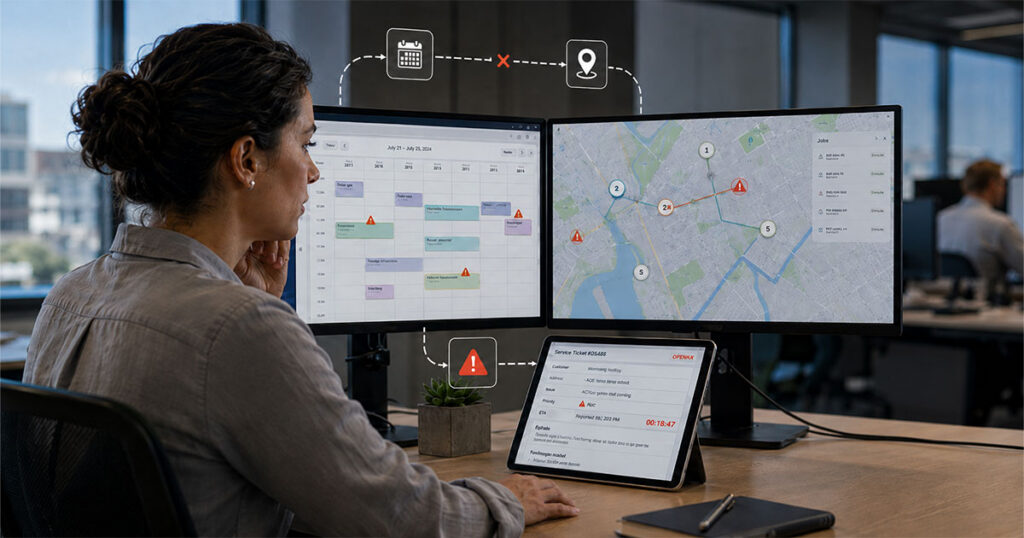
The calendar can look organized. Routes can look planned. Technicians can have a full day of work. But the service team may still not know which jobs are close to breach, which customer commitments are exposed, and which schedule changes will create a bigger problem later.
That creates a false sense of control.
A dispatcher may only discover the issue when a technician is delayed. A manager may only see the missed SLA in a report. A customer may only receive an update after they call to ask what happened.
At that point, the team is no longer managing the SLA. It is managing the consequence.
What connected SLA coordination looks like
Connected SLA coordination means the service request, schedule, dispatch process, technician workflow, and customer communication work as one flow.
The ticket should carry the right details from the beginning: service type, priority, customer information, location, SLA timing, required skills, and relevant notes.
Scheduling should then account for real operational constraints. That includes technician availability, skills, travel time, routes, workload, time windows, and SLA urgency.
Dispatch should continue the same logic. The technician receives the right information in the mobile app. The customer receives relevant updates. Service managers can see where risk is building. If something changes, the workflow can trigger the next action before the situation becomes an escalation.
This is the difference between appointment scheduling and connected field service execution.
A basic scheduling tool helps teams place work on a calendar. A connected FSM platform helps teams manage the chain of decisions that protects SLA performance.
What buyers should evaluate in field service SLA management
When comparing field service software, buyers should not only ask whether the platform includes scheduling.
They should ask whether scheduling is connected to the full service operation.
Useful evaluation questions include:
- Can SLA priority be visible from the moment a service request is created?
- Can scheduling consider skills, routes, time windows, workload, and SLA deadlines?
- Can dispatchers see which jobs are at risk before a breach happens?
- Can workflow logic trigger actions, alerts, or escalations automatically?
- Can technicians receive complete job information on mobile?
- Can customer updates happen without manual follow-up?
- Can managers review SLA performance by team, region, customer, and service type?
- Can the system reduce manual coordination between intake, planning, dispatch, and execution?
These questions matter for service leaders, CIOs, COOs, and transformation teams. SLA performance does not improve by adding another isolated scheduling layer. It improves when the full service process becomes easier to control.
Conclusion
SLA performance breaks down when scheduling is disconnected from the rest of field service execution.
The issue is rarely one late technician or one overloaded dispatcher. More often, it is a process where information moves slowly, risk appears too late, and teams depend on manual coordination to keep service commitments on track.
Scheduling tools are useful. But they are not enough on their own.
Field service teams need connected control across intake, planning, dispatch, communication, and execution. That is where Fieldcode creates value: by keeping SLA-sensitive work moving in one flow, with fewer manual checks and better visibility before problems become escalations.
Book a personalized demo to see how Fieldcode supports connected field service execution.
Knowledge tip
The best way to improve SLA performance is to treat it as an operational flow, not only as a reporting metric. If request intake, scheduling, dispatch, technician workflows, and customer communication are disconnected, SLA risk increases early. Connected field service management software helps teams see and act on that risk before it becomes a missed commitment.
FAQ
Why do field service teams miss SLAs even when they use scheduling tools?
Field service teams miss SLAs when scheduling is disconnected from intake data, SLA rules, technician skills, route planning, dispatch updates, and customer communication. The schedule may show assigned work, but the team may not see SLA risk early enough to act.
What should companies look for in field service SLA management software?
Companies should look for software that connects SLA data with scheduling, dispatch, technician workflows, customer updates, and reporting. This helps teams identify risk earlier, assign the right technician, reduce manual follow-up, and manage service commitments with better control.