Service Summit 2026: 5 takeaways on AI and the future of customer service
This article is also available in German
AI was a central topic at Service Summit 2026, but the discussions went well beyond what the technology can automate. How do companies use AI to improve customer experiences? Where does human expertise stay essential? And what does it take to turn AI capabilities into reliable service?
Service Summit 2026 took place on November 4 and 5 in Düsseldorf. Across keynotes, masterclasses and discussions, customer service professionals shared practical experiences with AI agents, automation, service quality and the changing role of their teams.
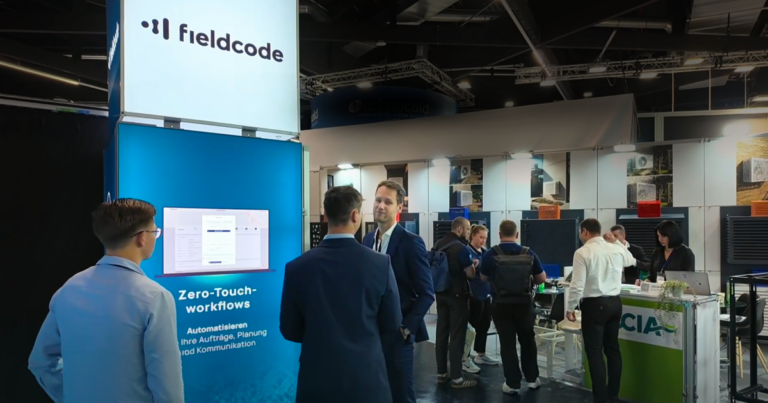
Fieldcode joined as an exhibitor, and our CEO Matthias Lübko showed how AI-supported scheduling and automated workflows connect customer service with field operations. Here are five takeaways from the event and what they mean for the future of customer service. The short recap video below captures the atmosphere.
1. Successful AI adoption starts with better service, not more automation
AI agents can answer questions, process requests and support customers around the clock. But automating more interactions doesn’t automatically deliver better service.
A recurring theme at Service Summit was the need to look beyond automation rates and focus on the problems customers actually experience.
Prevent the contact instead of handling it
In her keynote, “We’re Automating the Wrong Thing: Why AI Doesn’t Solve Tickets, It Just Keeps Them Alive,” Lisa Koszak from MEGABAD challenged a common approach: using AI to handle customer requests that teams could have prevented in the first place.
Consider a customer who contacts support because a technician missed an appointment. An AI agent might handle the conversation efficiently, apologize and arrange another visit. But the customer has still experienced a service failure.
The bigger improvement comes from understanding why the appointment failed and stopping it from happening again. For service organizations, this means looking at the entire customer journey, identifying recurring problems and using automation where it genuinely improves outcomes.
The question is not simply how many interactions AI can handle, but how much better the service becomes.
2. Human expertise stays essential, even as AI takes on more work
Another important message from Service Summit was the continuing role of people in customer service.
As AI handles routine questions, processes information and completes tasks independently, human involvement becomes more valuable, not less. Teams can dedicate more attention to situations that need empathy, experience and judgment.
Decide which conversations deserve a person
Pierce Buckley from babelforce explored this in his session, “Humans on the line: Why the most human calls are also the most automated.” He focused on identifying the conversations that deserve human attention and using automation to support them.
This distinction matters in practice. A customer checking an appointment time may feel comfortable speaking with an AI agent. Someone who faces repeated service failures, a critical outage or a sensitive complaint may need a person who understands the situation and can decide beyond predefined rules.
Keep people involved behind the scenes, too
People also play an important role behind the scenes. AI systems need oversight, performance monitoring and continuous guidance. Teams must recognize when automation works, when it needs adjustment and when a person should take over.
At Fieldcode, the same principle guides Zero-Touch automation. Voice AI agents can handle routine customer calls and appointment requests, while dispatchers and service managers keep control of operational exceptions and decisions that need human expertise.
Effective automation creates more room for the human expertise that customers still need.
3. AI is only as useful as the information behind it
AI agents can communicate naturally, but their ability to give useful answers depends on the information and systems they can access. This was a major topic across the Service Summit program.
Salesforce explored the importance of customer context in its keynote, “Context Over Tools: Why Service AI Agents Can’t Solve Problems Without Real Customer Data.” Other discussions addressed the challenges of disconnected systems and customer information that companies collect but never turn into action.
A simple question exposes the gap
The difference becomes clear with a simple customer question: “What’s happening with my service request?” An AI agent may understand the question perfectly. But without access to the current case, appointment details or service progress, it cannot give a reliable answer.
Human agents face the same challenge. When information sits across CRM, ticketing, scheduling and other operational systems, employees spend time searching for updates or contacting colleagues.
Connect systems so information follows the request
Connecting these systems lets information move with the customer request. An agent can see the latest status, an appointment change can trigger a customer notification, and completed work can update the original service record.
For organizations that manage onsite services, this connection matters even more, because the customer experience depends on activities outside the contact center. The value of AI therefore depends not only on the model itself, but also on the quality, accessibility and reliability of the information behind it.
4. Customer experience depends on what happens after the conversation
A customer service interaction may end in minutes, but resolving the customer’s issue can take much longer. This was the focus of Fieldcode CEO Matthias Lübko’s presentation, “Service with AI-supported scheduling and workflows.” Matthias demonstrated how connected service processes support the journey from the first customer request through planning, onsite execution and completion.
Where manual handovers break the journey
Take a customer who reports a technical problem that needs an onsite visit. Someone must record the request correctly, assign the right technician, confirm the appointment and keep the customer informed.
When separate teams and manual handovers carry these steps, delays and communication gaps creep in. Customers call again for updates, appointments change, and service teams spend extra time coordinating the work.
How Zero-Touch Field Service Management closes the gap
Fieldcode addresses these challenges through Zero-Touch Field Service Management, which combines automated workflows, AI-supported request processing, automated scheduling and dispatching and customer communication. The platform prepares requests automatically, technician assignments account for skills, availability, location and service requirements, and customers receive updates as the work progresses.
The aim is to reduce unnecessary manual coordination while giving service teams greater visibility and control.
For customer service leaders, the lesson extends beyond field service: a positive customer interaction matters, but the experience is only complete when the team resolves the customer’s issue.
5. Reliable AI needs ongoing monitoring and improvement
Launching an AI agent is an important milestone, but it doesn’t end the implementation. Several Service Summit sessions explored what happens once AI systems handle real customer interactions.
In “The Production Gap: Why Enterprise Voicebots Fail After Week Three,” Oliver Schlögl from Sipfront addressed the importance of testing voicebots under realistic operating conditions. Daniel Krantz from VIER also shared practical lessons for AI agents, including choosing appropriate use cases, human oversight, integration, monitoring and continuous improvement.
These topics highlight an important challenge: an AI agent that performs well in a demonstration must also handle unexpected questions, incomplete information, changing conditions and requests it cannot resolve on its own.
Measure more than automation volume
Organizations therefore need to monitor more than the number of automated interactions. Useful measures include successful resolution rates, requests transferred to employees, repeat contacts, customer satisfaction and the accuracy of the actions AI takes.
For service processes that involve appointments or onsite work, monitoring should extend to what happens after the interaction. Did the system schedule the appointment successfully? Did the customer receive the correct information? Did the technician complete the work as expected? These insights help teams see where AI needs better information, additional workflow rules or human involvement.
Long-term success depends on treating AI as an operational capability that needs continuous attention, not a one-time technology deployment.
What can customer service leaders take away from Service Summit 2026?
The discussions in Düsseldorf highlighted both the opportunities and responsibilities that come with AI adoption. Companies can automate more routine work, respond faster and make better use of customer information. At the same time, successful customer service still requires human judgment, connected processes and a clear focus on the experience customers receive.
For organizations looking to develop their service operations, five priorities stand out:
- Focus on customer outcomes. Identify recurring service problems and opportunities to prevent unnecessary contacts.
- Keep people involved where they add value. Define when AI should act independently, when it should support employees and when humans need to decide.
- Connect customer and operational information. Make the relevant data available across customer-facing channels and the systems that deliver the service.
- Look beyond the initial interaction. Follow requests through scheduling, execution and resolution rather than measuring contact center performance alone.
- Monitor and improve continuously. Track how AI performs in real situations and use the findings to improve workflows and service quality.
At Fieldcode, we see these priorities coming together in connected service operations. AI and Zero-Touch automation can reduce manual work, while employees focus on exceptions, service quality and the customers who need their attention.
To explore how Fieldcode connects customer requests with automated scheduling, field execution and customer communication, book a personalized demo.
Knowledge Tip
Measure the full customer journey, not just the first response.
Review a sample of recent customer requests and compare the time to first response with the time to actual resolution. Look for repeat contacts, manual handovers and delays between departments. This can reveal opportunities to improve service processes that faster response times alone won’t address.
FAQ
When and where did Service Summit 2026 take place?
Service Summit 2026 took place on November 4 and 5 in Düsseldorf. Fieldcode joined as an exhibitor, and CEO Matthias Lübko presented how AI-supported scheduling and automated workflows connect customer service with field operations.
Does AI replace human agents in customer service?
No. AI handles routine questions and tasks, while people take over situations that need empathy, experience and judgment, such as repeated service failures, critical outages or sensitive complaints. People also oversee, monitor and guide the AI systems.
Why do AI agents need connected customer data?
An AI agent can only give reliable answers when it sees the current case, appointment details and service progress. Connecting CRM, ticketing, scheduling and other operational systems lets information follow the customer request, so agents and customers always see the latest status.
What is Zero-Touch Field Service Management?
Zero-Touch Field Service Management is Fieldcode’s approach to connecting customer requests with field execution. It combines automated workflows, AI-supported request processing, automated scheduling and dispatching, and customer communication, so teams spend less time on manual coordination.
Which metrics show whether an AI agent works well?
Track more than the number of automated interactions. Useful measures include successful resolution rates, requests that transfer to employees, repeat contacts, customer satisfaction and the accuracy of the actions the AI takes. For onsite services, also check whether the appointment succeeded and the technician completed the work.