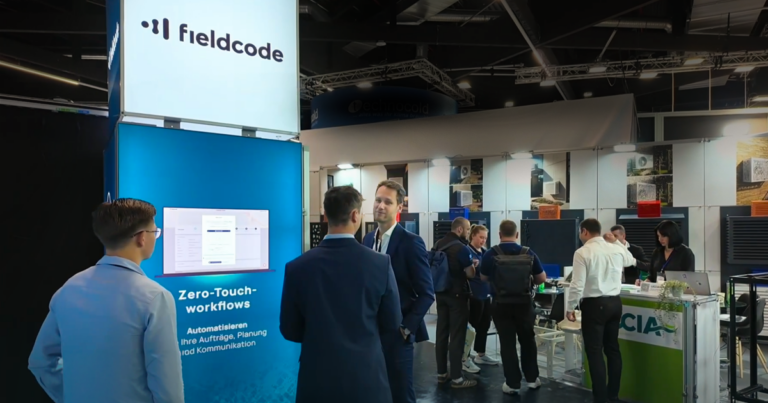
Top 5 takeaways from Maintenance Dortmund 2026
This article is also available in German
Maintenance Dortmund 2026 wasn’t about futuristic concepts. It was about operational pressure.
Across two days of talks and discussions, one pattern became clear: the industry isn’t debating digital transformation anymore. It’s trying to make it work in real conditions.
Here are the five themes that stood out — and what they signal for maintenance and service leaders.
1. AI is moving from prediction to execution
AI appeared in fault diagnosis, spare part recognition, resource planning, knowledge systems, and enterprise platforms.
But the focus wasn’t model sophistication. It was operational impact.
The real question has shifted from:
“Can we predict failure?”
To:
“What happens automatically after we detect something?”
If AI detects a risk but scheduling, prioritization, and assignment still require manual coordination, the value disappears quickly.
The takeaway: AI only pays off when it’s connected directly to workflows.
Detection without execution is just reporting.
2. Knowledge retention is becoming structural
Several sessions addressed knowledge monopolies and scaling senior technician expertise.
That’s not an HR issue. It’s an operational one.
When experienced technicians leave, they take decision logic with them. Documentation helps — but it doesn’t replace embedded judgment.
The smarter approach is turning expertise into structured workflows.
When troubleshooting logic, safety steps, and qualification criteria are system-guided, new technicians don’t depend entirely on memory. The system reduces variability.
Consistency becomes designed — not hoped for.
3. Spare parts visibility directly impacts uptime
Spare part recognition, connected part networks, retrofit strategies — these weren’t minor topics.
They reflect something maintenance teams already know: reliability depends heavily on preparation.
If scheduling decisions ignore part availability, execution becomes reactive. Technicians arrive without what they need. Repeat visits increase. SLAs suffer.
The shift we saw at the event was clear: part status, technician skill, and priority must be evaluated together before dispatch.
Integration is what stabilizes operations.
4. Firefighting mode is still common
One session explicitly focused on moving out of firefighting mode.
That resonated because many organizations are still reacting, despite investing in digital tools.
The issue isn’t lack of data. It’s fragmented workflows.
Tickets enter through multiple channels. Information quality varies. Escalations depend on individuals. Planning adjustments require coordination across systems.
That creates stress — and stress magnifies inefficiencies.
Leaving firefighting mode doesn’t require more dashboards. It requires fewer manual coordination points.
Structured intake.
Automated prioritization.
Skills-based assignment.
Real-time adjustments.
Predictability is a workflow decision.
5. Automation needs to start earlier
One discussion focused on Zero-Touch field service planning supported by AI voice agents.
That highlights something many teams underestimate: instability often begins at intake.
If information is incomplete or manually triaged, everything downstream becomes unstable. Planning gets reactive. Technicians arrive underprepared. Repeat visits increase.
When incident capture and qualification are structured from the start, execution becomes more controlled.
Automation shouldn’t begin at dispatch. It should begin at first contact.
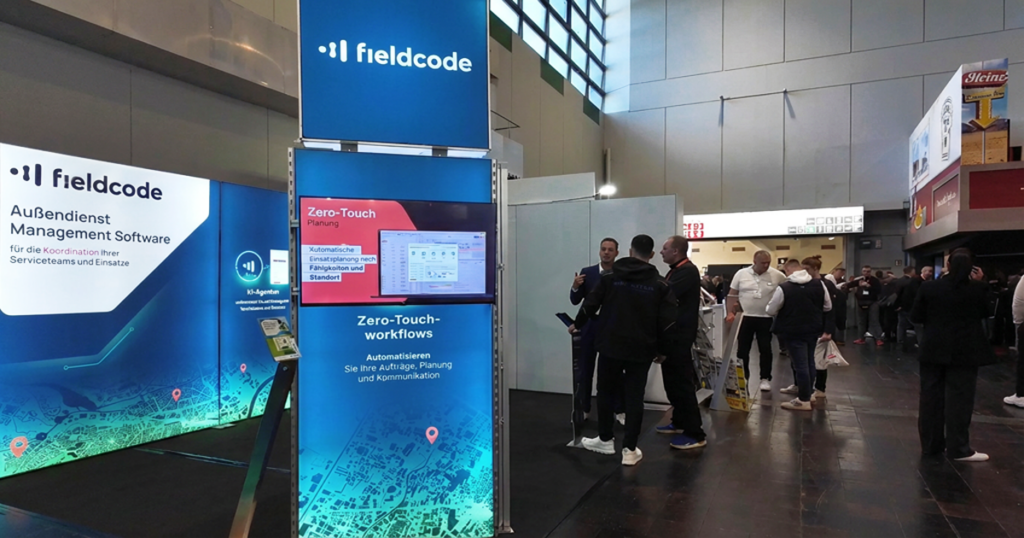
Here’s a short video from Maintenance Dortmund 2026, showing a few moments from the event and conversations at the Fieldcode booth.
Conclusion
Maintenance Dortmund 2026 didn’t introduce a radical new concept.
It showed an industry maturing.
AI isn’t experimental anymore. Knowledge systems aren’t optional. Spare part transparency isn’t a bonus feature.
The real differentiator now is execution maturity.
The organizations that move ahead won’t be the ones with the most analytics reports. They’ll be the ones where detection, decision, and dispatch are structurally connected.
If you want to see how this looks in practice, you can explore how modern field service management software connects intake, planning, and execution into one automated workflow. Book a personalized demo to see how structured execution reduces manual coordination across your service operations.
Knowledge tip
If your team is still reacting despite having monitoring tools in place, the issue usually isn’t data — it’s workflow structure. Modern field service management software connects ticket intake, skill matching, spare part availability, and scheduling into one automated chain. That reduces coordination friction and helps teams move from reactive handling to controlled execution.
FAQ
How can AI improve maintenance planning and scheduling?
AI improves planning when it automatically qualifies tickets, prioritizes work orders, checks part availability, and matches jobs to technician skills. When those steps are connected in one workflow, scheduling becomes more stable and less reactive.
How do companies reduce reactive maintenance?
Reducing reactive maintenance requires structured intake, automated prioritization, and skill-based dispatch. When work orders are standardized and planning decisions consider parts, SLAs, and asset criticality together, emergency interventions decrease.
How can maintenance teams prevent knowledge loss?
Knowledge loss is reduced when troubleshooting logic and safety procedures are embedded into workflows. Instead of relying on individual memory, systems guide technicians step by step, improving consistency across teams.