Fieldcode named a Representative Vendor in the 2026 Gartner® Market Guide for Field Service Management
This article is also available in German
Fieldcode has been named a Representative Vendor in the 2026 Gartner® Market Guide for Field Service Management. The report, authored by Jim Robinson and published on 28 July 2026, includes Fieldcode among its Representative Vendors.
What does Fieldcode’s inclusion mean to us?
We believe Fieldcode’s inclusion as a Representative Vendor marks an important company milestone and provides an opportunity to reflect on selected market-wide themes from the report alongside Fieldcode’s approach to addressing them.
Key themes in the 2026 Gartner Market Guide for Field Service Management
From Fieldcode’s perspective, the following market-general excerpts point to a connected shift: FSM modernization is broader than replacing scheduling tools, AI needs operational control, and service processes depend on reliable data exchange with surrounding systems.
Modernization beyond scheduling
“Field service providers that view modernization merely as a “scheduling and mobile work debrief replacement” risk underinvesting in critical strategic capabilities.”
Governed AI and unified data
“CIOs should seek AI-enabled FSM solutions with centralized, cross-functional governance and unified data models to avoid inadvertently bypassing existing analog, role-based safeguards.”
AI embedded in service workflows
“AI-embedded into service workflows: Capabilities such as AI scheduling optimization, knowledge retrieval in-field, multiagent operations and copilots are accelerating training ramp time and productivity.”
Quotes’ source: Gartner, Market Guide for Field Service Management, Jim Robinson, 28 July 2026.
How Fieldcode addresses these themes
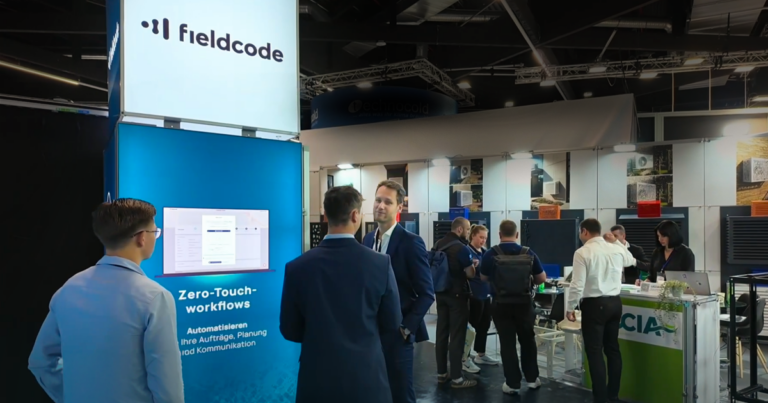
Fieldcode addresses these priorities through Zero-Touch field service automation. The aim is to connect the service process from request intake through planning, dispatching, mobile execution and completion, so routine work can progress through configured rules without requiring manual coordination at every step.
Moving beyond scheduling. Scheduling remains central to field service, but its effectiveness depends on the information and workflows around it. Fieldcode combines ticket preparation, automated scheduling and dispatching, route optimization, customer communication and technician execution in one operational flow. This helps teams manage the complete service lifecycle rather than optimize an isolated calendar.
Keeping AI inside controlled workflows. Fieldcode’s AI LLM workflow actions run within configured service workflows. Teams define the prompt, select the data available to the action, and determine how the output can be used. AI can summarize, translate, clean or prepare service information for the next workflow step, while the organization retains control over the process logic and exceptions.
Connecting data with operational execution. Field service does not operate in isolation. Service requests, customer records, billing information, asset data and technician updates often move between multiple systems. Fieldcode supports this through APIs, interfaces and configurable workflows and forms that allow organizations to structure how information enters, moves through and leaves the FSM process.
Designing automation around real service rules. Zero-Touch automation does not mean removing people from every decision. It means automating predictable work according to defined skills, SLAs, availability, routing constraints, and workflow conditions, while making exceptions visible to the people responsible for resolving them. This balance is important when organizations want to increase automation without losing operational control..
Final thoughts
For service organizations evaluating their next FSM platform, the practical question is no longer only whether the software can schedule technicians. It is whether the platform can connect data, decisions, and execution across the service lifecycle while providing a controlled foundation for automation and AI. Book a personalized Fieldcode demo to see how this approach can be applied to your own workflows.
Gartner, Market Guide for Field Service Management, Jim Robinson, 28 July 2026,(Accessible to Gartner subscribers only)
GARTNER is a trademark of Gartner, Inc. and/or its affiliates.
Gartner objectivity disclaimer: Gartner does not endorse any company, vendor, product or service depicted in its publications, and does not advise technology users to select only those vendors with the highest ratings or other designation. Gartner publications consist of the opinions of Gartner’s business and technology insights organization and should not be construed as statements of fact. Gartner disclaims all warranties, expressed or implied, with respect to this publication, including any warranties of merchantability or fitness for a particular purpose.